2017 Ford E 350 Cutawa Reading Aluminum
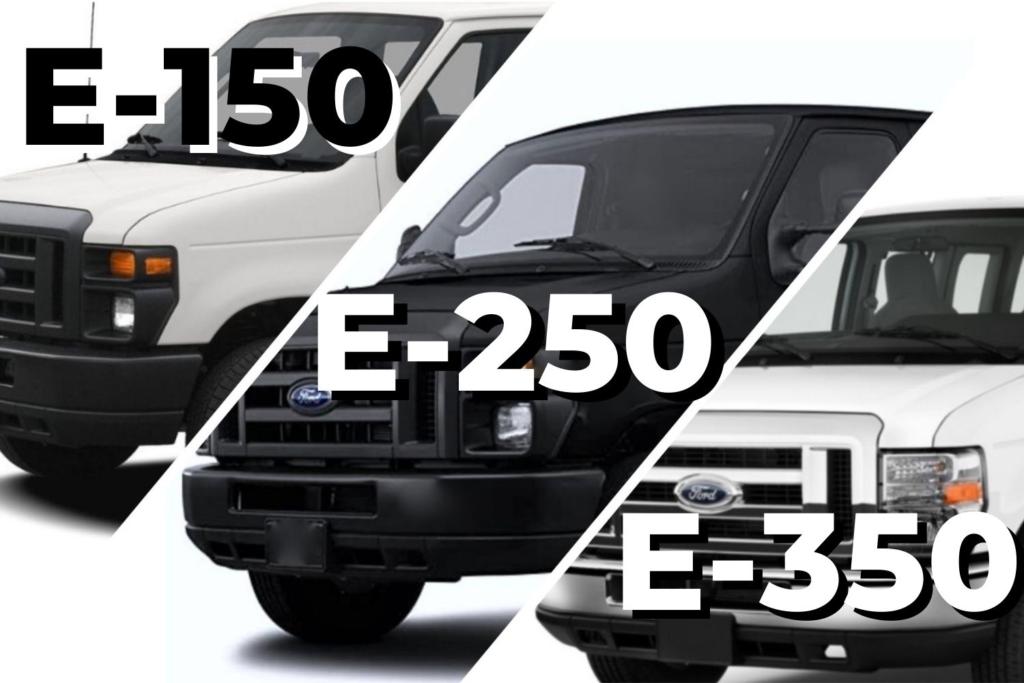
Are you confused near the difference betwixt the dissimilar types of Ford E-serial vans? What exactly is the difference between Ford E-150, E-250, and E-350 vans? In this mail service I will explain the difference between these common Ford E-serial vans, and why you might cull i over another.
(And if you lot are curious, the other American vans have a like relationship. So you tin can roughly apply the same explanation to Chevy Express and GMC Savana 1500, 2500, 3500).
Check out my post that covers all types of vans: How To Choose A Van For A Campervan Conversion.
The Basic Difference
In easy to understand terms, the higher the number, the more heavy-duty the van is and the more weight it can booty. And it means the vans are built with unlike parts to conform more weight (i.e. bigger engines, more than robust suspension/brakes/etc.
Or if you're familiar with Ford Trucks, it'south a similar relationship betwixt Ford F-150, F-250, and F-350. After all, these Ford vans are heavily based on their truck platforms.
What is Econoline?
Econoline is the former proper name of the Ford E-Series vans. Bated from updates throughout the years, they are the same line of vehicles. The Econoline and Due east-Series vans have been in production since 1961. Nevertheless, after 2014 it was discontinued in passenger and cargo models. The only models available from 2015-Nowadays are the stripped chassis or cutaway chassis models.
Terms To Know
Curb Weight – How much a vehicle weighs without passengers or cargo.
GVWR – Stands for Gross Vehicle Weight Rating, and it's the maximum weight that a vehicle tin can accomplish including passengers, cargo, gasoline, fluids.
Payload – How much weight in cargo and/or passengers a vehicle can carry. You subtract GVWR – Curb Weight = Payload.
What Does The Number Signify?
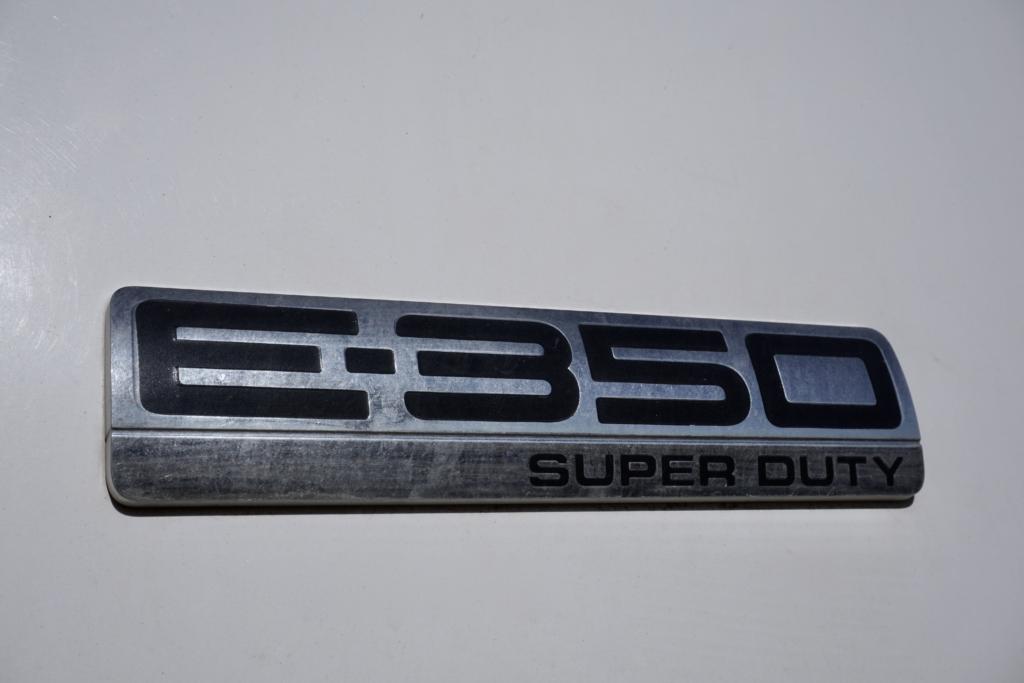
The number in the proper noun of each van indicates their increasing payload (how much weight information technology can haul).
There are two main classifications that help group similar vehicles.
The get-go is how the regime classifies vehicles (for fuel efficiency). They classify Low-cal-Duty as whatsoever vehicle with up to 8500lbs GVWR or up to 4000lbs payload. The Ford Eastward-250 and East-350 are both above that threshold, and thus classified equally heavy-duty. The Ford E-150 was light-duty up until 2006 when information technology surpassed the 8500lbs GVWR threshold, and joined the other vans as a heavy-duty classification.
The second mutual shorthand way to classify vans is by referring to their payload in terms of tons {ane ton = 2000lbs}. So the E-150 is ½ ton, E-250 is a ¾ ton, and E-350 is a one ton. But this system is wildly outdated because the payload ratings have soared by those definitions. For example, the "one ton" 2014 Ford E-350 has a payload of 4,060lbs, which is literally two tons! And yet, people still utilise these antiquated terms.
How Are They Congenital Dissimilar?
In guild to haul more weight, each increasing van has certain parts upgraded to accommodate a higher payload. The E-250's and E-350'southward are congenital with more than robust interruption, brakes, etc. They may also accept larger engines, improve transmissions, and a college output alternator. These changes results in a higher curb-weight but ultimately the ability to haul more than stuff.
Payload Comparison
It's important to cull a van with an appropriate payload rating for your intended use. As I stated above, the E-350 has the highest payload, followed by E-250, and finally E-150 at the bottom. And generally payloads and towing capacity have increased over fourth dimension every bit the technology improves.
Only at that place is one massive outlier, outside the normal incremental changes. Between 2006 and 2007 the East-150 saw a desperate payload increase. This increase resulted in the E-150 switching classification from "calorie-free-duty" to bring together the E250 and E350 every bit a "heavy-duty" vehicle. That change is illustrated below.
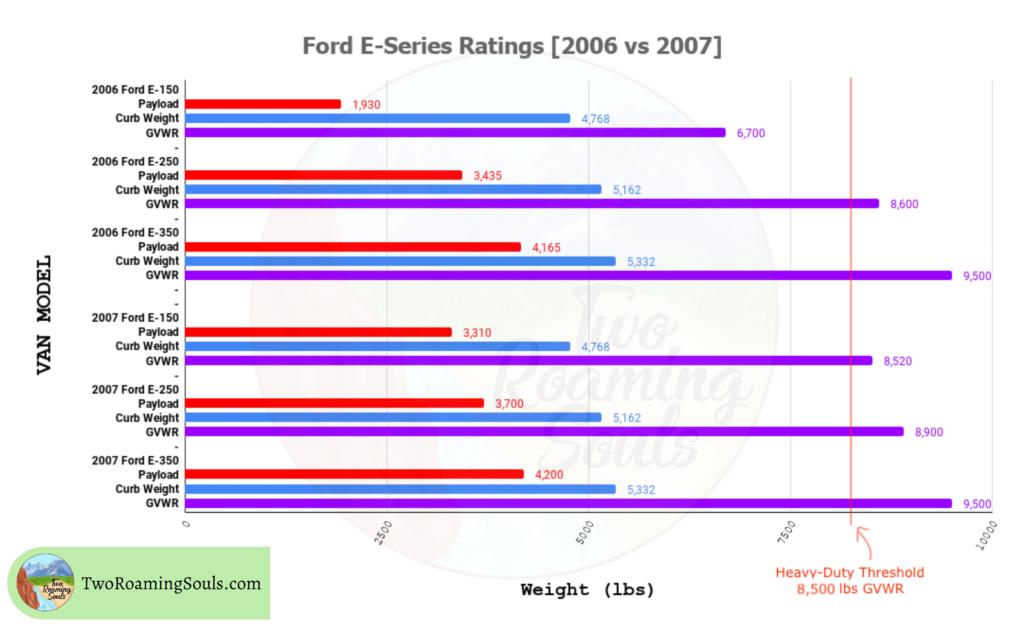
How they managed to increase the payload by over 1000 lbs without increasing the adjourn-weight is rather surprising (or concerning). I wonder if these postal service 2007 E-150's are really congenital to handle those loads, or if they will break downward faster.
Why Did Ford Phase Out The "Lite-Duty" E-150
Ford intentionally got rid of the low-cal-duty Due east-150 because EPA regulations for fuel efficiency were becoming increasingly harder to reach with light-duty vans. They did this by boosting the GVWR over 8,400lbs to force reclassification equally heavy-duty.
This EPA fuel-efficiency pressure has driven almost companies to bail on their low-cal-duty vans (Chevy got rid of the Express 1500 in 2014). Past 2020, most automakers have created a wide gap betwixt their heavy-duty full-size vans and their small city-oriented light-duty vans (like Ford Transit Connect and RAM Promaster City)
Towing Chapters
The Ford E-350 is, as expected, the strongest in the towing category. However, somewhat counterintuitively, the East-250 has less towing capacity than E-150.
Length & Wheelbase
All Eastward-Series vans have a 138" wheelbase (distance betwixt front end and rear beam). Even so in that location are Extended versions available for E250 and E350.
Cargo Vs. Rider (Wagon)
You will run into these vans offered in cargo or wagon models. Basically, the cargo vans are work vans that are merely an empty metal beat in the back. There are usually only windows on the dorsum doors.
The wagon models (aka passenger) are meant for carrying people. They volition have seats, windows on all sides, a finished interior, and possibly climate control, lights, charge ports, speakers, etc.
What Does XL and XLT Stand For?
XL and XLT don't accept anything to practise with the length or size of the van, unlike many people assume. These titles stand for the different trim offerings. 40 and XLT are generally reserved for the passenger (wagon) models because they include extra features that make the van more comfy for passengers. It can include rear air-conditioning, satellite radio, nicer upholstery, ABS and more than.
That's pretty much the end of the hands quantifiable differences. Just smart buyers will however wonder how these different models compare in categories with larger variance, such equally Fuel Economy, Cost of Ownership, and Longevity.
I've spent hours researching the more nuanced differences betwixt Due east-Series vans. The problem is that finding concrete evidence to support claims is difficult because the real-globe doesn't function like some perfectly controlled scientific discipline experiment.
- The manufacturers and dealers claims are sometimes not consequent with the real-world numbers.
- Or you can turn to automotive websites {like Edmunds.com , Autoblog.com , etc} who either regurgitate the manufacturers' claims, or try (and possibly fail) to make predictions nearly real-earth MPG, Cost of Ownership, etc.
- And lastly, you lot have just regular people on forums and blogs providing their own anecdotal "evidence" to support their claims. And plain, that method is subject to mistake.
So I've done my best to summarize the things that are generally accepted as true. That is, multiple sources confirm roughly the same information.
But one huge slice of advice that I hear echoed over and over from fleet owners and mechanics is this:
How yous treat your van is much more of import than which i you have. Whatsoever marginal difference in fuel economy, repair costs, and longevity can exist obliterated past poor ownership.
Fuel Economy
The fuel economic system more often than not gets worse with each increasing model. But the difference between Ford Eastward-150, East-250, and Due east-350 is just a few MPG.
And this of course depends on how you lot use the van. Because an overloaded E-150 may become worse MPG than an E-350 working comfortably within it'south GVWR.
Ride Comfort
The fact that these vans are tuned for specific payloads, means that they ride smoother when loaded properly. So an empty E-350 is going to be a really rough ride. Conversely, an overloaded E-150 will also be rough, because the suspension is bottoming out. If you bulldoze the van empty occasionally, then the Eastward-150 and E-250 are better tuned for alternate between loaded and un-loaded.
Repairs and Maintenance
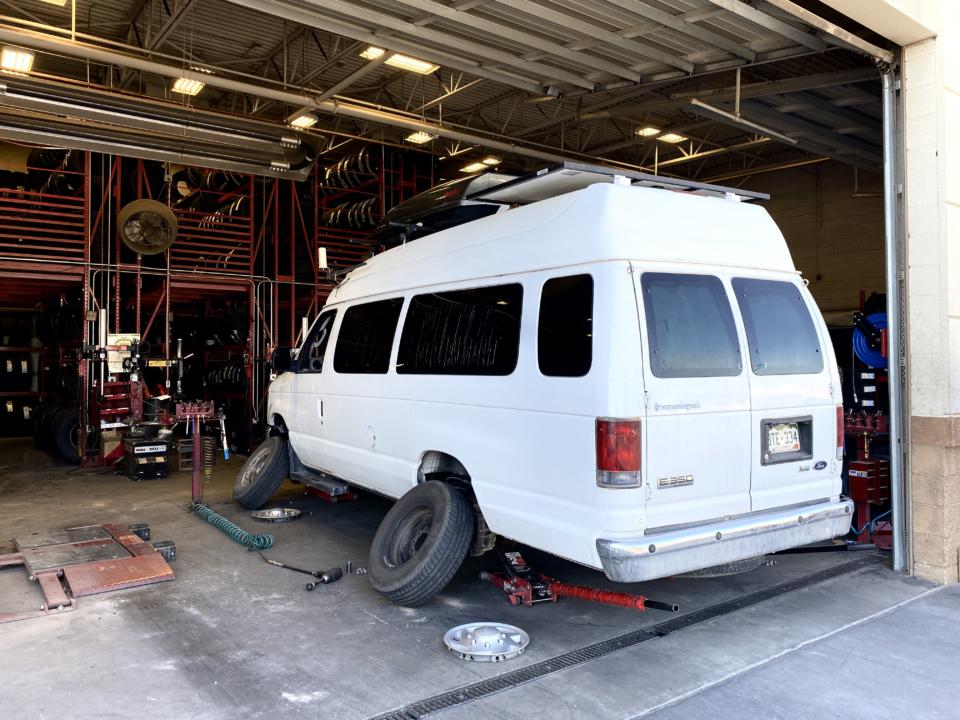
The repairs and maintenance will on boilerplate cost more for each increasing model.
Longevity
A WELL-MAINTAINED Eastward-Serial van should last until 250-300k miles on the original engine. And the transmission usually bites the dust around 150-250k miles.
As far every bit the departure between Ford E-150, E-250 and E-350 vans, I've but seen anecdotal claims that the 250'southward and 350'due south vans final longer. Just it'southward hard to find concrete evidence of this in the real earth. It may be that E-150 owners are just overloading their vans, so they don't last equally long.
Conclusion: Which Van Should y'all Cull?
The primary gene when choosing from the E-Series lineup is Payload and Towing, since that is the principal quantifiable difference between Ford Due east-150, Eastward-250, and E-350. At the finish of the day, y'all need a van capable of handling the weight yous need to motility. Only equally of import is finding a van that'southward in practiced mechanical shape.
In the context of campervan conversions, the weight of your conversion materials will dictate the payload required. This will depend on what type of conversion you're planning. A general rule of pollex is that E-250 and 350 are best for elaborate conversions for ii or more people with wooden furniture, h2o tanks, batteries, and all your belongings. The E-150 is better suited for builds with lightweight materials (plastic, foam, aluminum) or "weekend-warrior" blazon conversions that aren't loaded with so many personal belongings.
If you programme on towing, then Eastward-350 can tow the most. Just just recollect the caveat that Due east-150 has more towing than the E-250. However, unless you're towing something like a large boat or camper trailer, then any E-Series will practice the job.
If you lot must have an Extended van, and so you are express to the Due east-250 and East-350.
wingfieldhinagesphe.blogspot.com
Source: https://tworoamingsouls.com/whats-the-difference-between-ford-e-150-e-250-and-e-350/
0 Response to "2017 Ford E 350 Cutawa Reading Aluminum"
Enviar um comentário