Read a Csv File and Display on Ui in C#
AI-powered Visual Web Automation
UI.Vision RPA's prototype and text recognition let y'all to write automated visual tests with UI.Vision RPA - this makes UI.Vision RPA the first and only Chrome and Firefox extension (and Selenium IDE) that has "👁👁 eyes". For more information delight encounter visual UI Testing and the XClick command.
AI-powered Visual Desktop Automation
UI.Vision RPA can not only come across and automate everything inside the web browser. The same image and text recognition engineering science tin can automate your desktop also (Robotic Process Automation, RPA). For more data delight see Desktop Automation and the XClick control.
Classic Web Automation, fully Selenium IDE compatible
UI.Vision RPA is a open-source culling to iMacros and Selenium IDE, and supports all important Selenium IDE commands. When you invest the fourth dimension to acquire UI.Vision RPA, you learn Selenium IDE at the same time. You can fifty-fifty import Selenium IDE exam cases.
Automation by Example
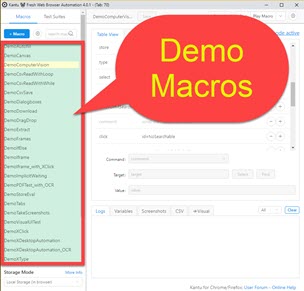
Often it is all-time to learn from examples. UI.Vision RPA installs many ready-to-run demo macros that showcase its features and all important commands.
RPA Software Screencasts
The RPA Software Youtube channel has UI.Vision videos that highlight and demo the RPA features. For example:
- Spider web and Desktop Automation with UI Vision
- Codeless UI Automation for Desktop apps
- Testing Discord App Chat with XClick and XType ${KEY_ENTER}
- Automating Drag & Drop with Epitome Recognition
- Set Date Control
- Run 1 macro after another with the UI Vision command line API
Command Reference
Image-driven Commands (AI powered Web and Desktop Automation)
Desktop Automation Commands
Screen Scraping Commands
Selenium IDE Commands (encounter also How is UI.Vision RPA related to Selenium IDE?)
Web Scraping with Selenium IDE
Command Line API Commands - control UI.Vision RPA from any program or script
Acme
Menses Control
UI.Vision RPA was the first web macro recorder with congenital-in menstruum control commands like if/else/endif, while/endWhile or GotoIf. Follow the links for more than details and examples.
Superlative
Loop button
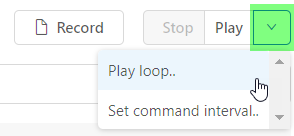
The dropdown side by side to the Play push button contains the loop characteristic - run macros every bit a loop. Looping a macro is useful for doing bones load testing with the Selenium IDE, for functioning monitoring or to but exam the stability for the test case (macro) itself. The csvRead control to read a CSV file line by line makes also use of the LOOP button.
Meridian
Read and write CSV files
Comma-separated values (CSV) files are useful as information input for data-driven testing/automation or as data output for web scraping. In UI.Vision RPA for Chrome the csvRead and csvReadArray commands give yous access the information within CSV files, and the csvSave and csvSaveArray commands allow you to write exam results or extracted values to a CSV file.
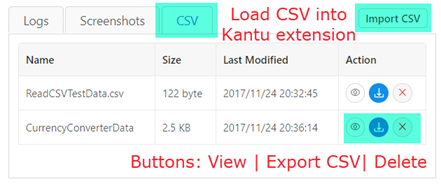
The CSV director tab (shown in the screenshot) allows you to import, export, view and delete CSV files to the local storage of the extension. And so the CSV files are not direct accessed from the hard drive, only they are stored within the web browser. The reason for this is that mod browser extension accept no access to your hard drive. Just like with the macros, all CSV files are stored locally within your browser (technically called local storage), nothing is uploaded to whatever kind of cloud service.
If y'all have the UI.Vision RPA FileAccess XModule installed, you can switch the macro storage manner to Hard-Drive Storage. This will also redirect all CSV read and write functioning directly to the hard drive. By default, CSV files are then stored in the "UIVision/datasources" binder.
Pinnacle
Automating File Upload
Content moved: The file upload tutorial has now its own page:
File uploads with Selenium IDE and File uploads in Firefox.
Automating File Download
If yous all need is a simple download, there is naught special to do. If a click command triggers a download, UI.Vision RPA handles it automatically. Past default, UI.Vision RPA does non cease and wait for the download to complete, the macro continues with the next command(s).
OnDownload | new file proper noun | (expect for download to complete:) true/false
For more control over the download there is the OnDownload control. Information technology allows you to overwrite the default file name with a custom name. And with "true" in the third column you tell UI.Vision RPA to wait for a download to complete before continuing with the adjacent control. UI.Vision RPA waits for max. timeout_download seconds. This choice is great for checking the performance (download speed) of a file download. If you need to measure the verbal download time, you can exercise that with the value of the !RUNTIME internal variable. The max. await time between a mouse click on the link and the actual download start is limited by timeout_wait. OnDownload tin can be at whatever place in the macro as long as it is reached earlier the download is triggered.
Height
Internal variables
Some parameters can be controlled via Internal variables. All internal variables are valid only per macro run and they exercise not change the global default values. In other words, internal variables overwrite global default values inside the macro they are used.
- !clipboard (read/write) - write to or read from the computer'southward clipboard (copy and paste).
- ${!cmd_var1}, ${!cmd_var2}, ${!cmd_var2} (read) - the value of these three variables tin can exist set up via the control line with the cmd_var1/ii/3 switches.
- !col1, !COL2,... (read but) - Values read from CSV file with csvRead
- !csvLine (read/write) - storing values to this variable appends them to the line used by csvSave. Apply shop | NULL | !csvLine to overwrite (not append) the current values.
- !csvReadMaxRow (read) - In some cases you may need to now how many lines are in a CSV file, or you lot want to read the last (well-nigh recently added) line of a CSV file. In both cases the internal variable !csvReadMaxRow can assistance. After the first csvRead, this value is set the number of lines in the CSV (example here)
- !csvReadStatus (read) - true if the last csvRead control was successful. Typically fake if at that place are no more than lines in the CSV file. And then together with the while command, this can be used to read CSV files where the number of rows is unknown. Please meet the DemoReadCSVwithWhile macro for a code example.
- !csvReadLineNumber (read/write) - true sets the line number for the csvRead command to read. If not used, the value of !LOOP is used for the line number and !csvReadLineNumber is fix to the same value.
- !ErrorIgnore (read/write) - This is a very useful internal variable. If ready to true with store | true | !errorIgnore the macro execution continues after an error. Information technology is often used with flow control or to test/click links that sometimes exist and sometimes not. Yous tin can change back to the normal behavior at any point in the macro with store | false | !errorIgnore. Related forum post: RPA Error handling options
- !LastCommandOK (read only) [DEPRECATED, employ !statusok instead] - contains the condition of the terminal executed command (true of successful, or fake if the command encountered an error. Apply with !ErrorIgnore set to true and so the macro execution continues later an mistake. The Repeat control that does not influence the status, so it can be used for logging the value of !LastCommandOK without changing its value.
- !Last_Downloaded_File_Name (read only) Get the name of the downloaded file. This requires ONDOWNLOAD to be inside the macro.
- !statusOK (read/write) - contains the status of the macro execution. In one case an error happens !statusOK is set to FALSE.
Typically this variable is used to get the result of the VERIFY... commands and the storeText / storeValue / storeChecked / storeAttribute web scraping commands, which do non cease at an error. If you desire to apply it with other commands then call up to fix !ErrorIgnore to true so the macro execution continues after an error. Only so will !statusOK be useful, as otherwise the macro stops at an error anyway.
!statusOK does not get reset by a successful command. Once !statusOK is ready to "false" by an error, it remains "false", even if the next commands succeed. Only you tin can utilize store | true | !StatusOK to manually reset it. Related forum post Simulate Try/Catch in Selenium IDE
- !StringEscape (read/write) – If true \n \r are interpreted as escape sequence (default). If faux they are interpreted literally (more details). This applies to TYPE and SENDKEYS, but not XTYPE.
- !LOOP (read simply) – current value of the loop counter (one,ii,3… etc). Peachy for utilise with @POS=${!LOOP} to wheel through a listing of links.
- !MACRONAME (read) - Proper noun of the macro this control is in
- - !OCRLanguage=ENG/..., !OCREngine=one/2 => Please see OCR screen scraping for details on how to command the text recognition.
- !REPLAYSPEED (read/write) - Fix the replay speed to FAST (no delay between each step), MEDIUM (short, "human similar" delay) or "Deadening" (2 seconds delay). Some other pick is NODISPLAY. It stops IDE GUI updates for the fastest possible replay speed.
- !RUNTIME (read) - Time elapsed since macro offset. This value is very useful for performance testing and performance monitoring
- !RUNTIME (read) - Fourth dimension elapsed since macro showtime. This value is very useful for performance testing and performance monitoring
- !GLOBAL_TESTSUITE_STOP_ON_ERROR (read/write) tells UI Vision to finish the test suite execution after an error. The default settings is "fake", so by default the RPA software continues to run all tests. Note that this is a global variable, then y'all simply need to set it in one of the macros of your test suite! Typically, of course, y'all would employ information technology in the first macro.
- !TIMEOUT_DOWNLOAD (read/write) - Time limit for file downloads if UI.Vision RPA is told to wait for a download to complete via OnDownload | file name | true
- !TIMEOUT_MACRO (read/write) - Limit for the overall macro runtime. The default value is 300s (5 minutes).
- !TIMEOUT_PAGELOAD (read/write) - How long to await for page load
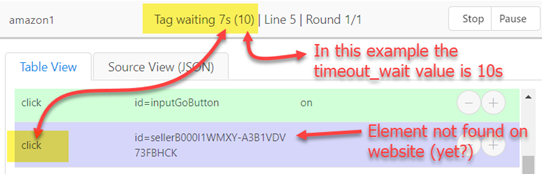
- !TIMEOUT_WAIT (read/write) - How long to wait for an element to announced before reporting an chemical element not constitute error (implicit waiting)
- !TIMES (read) - Loop counter for the times loop. In nested times loops, !times has the value of the currently active loop. Now we ensured that the value of is the value of the loop that information technology is currently in.
- !URL (read but) - contains current browser URL that yous run across in the address bar. Previously, the storeLocation command was needed for this.
- !WaitForVisible - past default the implicit waiting waits for an chemical element to announced and become visible. If you do not want to await for the element be visible (typically considering it never becomes visible) use store | false | !WaitForVisible. And so waiting for visible is turned off for all following commands until you lot ready information technology once more to true.
Meridian
Source Code Tab
The source code tab is the useful to view, search, edit and copy & paste source lawmaking snippets:
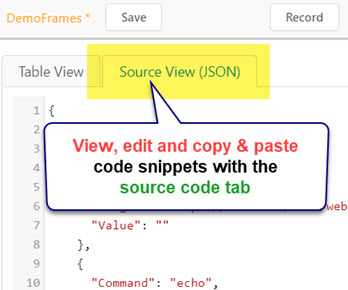
You lot can utilize the source code tab to copy and paste code snippets to/from the UI.Vision RPA forum. If yous paste lawmaking in the forum please remember utilise the lawmaking tag in the forum editor.
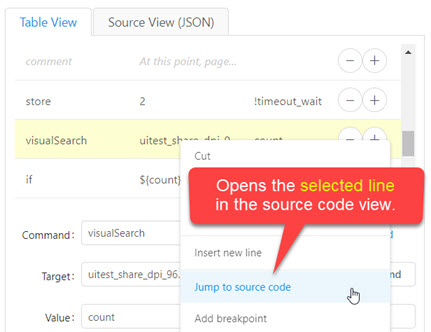
In the tabular array view you can use the "Jump to source lawmaking" context menu particular to jump directly to the JSON code of the currently selected command. In other words, this feature opens the source code view tab and automatically scrolls down to the correct position.
Performance Monitoring/Testing
The !RUNTIME internal variable contains the macro runtime and makes performance testing piece of cake. In the case below we offset click on the "Start OCR button " (OCR.space) and store the current run time in a variable. Then UI.Vision RPA waits for the consequence (= web element) to announced. Once the element is constitute and the macro execution continues nosotros measure the fourth dimension once again by reading the electric current value of !RUNTIME. The difference is the runtime performance of this footstep. In a side by side step you tin, for example, write the value of "TimeForThisStep" to a CSV file with the csvSave characteristic.
Performance Monitoring/Testing
The !RUNTIME internal variable contains the macro runtime and makes functioning testing easy. In the case below nosotros offset click on the "Kickoff OCR button " (OCR.infinite) and store the electric current run time in a variable. Then UI.Vision RPA waits for the result (= web element) to announced. Once the element is found and the macro execution continues we measure the time once more by reading the current value of !RUNTIME. The departure is the runtime performance of this step. In a next step yous tin, for example, write the value of "TimeForThisStep" to a CSV file with the csvSave feature.
| click | link=Commencement OCR! | Get-go the procedure to mensurate (in this case an OCR conversion) | |
| store | ${!RUNTIME} | StartTime | Shop the start fourth dimension |
| click | //*[@id="sucOrErrMessage"]/stiff | Wait for the "Completed" message to appear... | |
| store | ${!RUNTIME} | EndTime | Log the current macro runtime |
| storeEval | ${!EndTime}-${!StartTime} | TimeforThisStep | Calculate the runtime of the "yellow" step, which is the difference betwixt commencement and terminate time. |
Top
Test status reporting
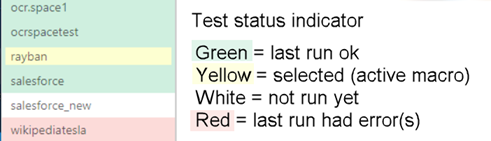
The background of each macro indicates its test status: White = not nevertheless run, Light-green = concluding run was ok and red = terminal run had an error.
Setting the right macro replay speed
In (gear icon) > Replay Settings you can select the replay speed. FAST (no delay), MEDIUM (0.3s, default) and Dull (2s). With FAST, UI.Vision RPA replays the macro as fast as it can. This is faster than any human could type, so on some websites that can cause issues, as they have not been tested for such a speed and sometimes Javascript code can non respond quickly enough. Typically MEDIUM is a good compromise between speed and being website-friendly. Wearisome can exist useful for testing and debugging.
Y'all tin can change the default replay speed in the settings menu (encounter screenshot above) or within a macro with shop | SLOW/MEDIUM/FAST | !replayspeed.
Superlative
Position back up in link text locator
With CLICK link=Download@POS=3 yous instruct the IDE to use the n-thursday (here due north=three) occurrence of a locator. This is useful, for example, if a take a website with many download links, and y'all want to click the n-th once. POS is only supported with the "normal text" locator link=... but non with XPATH and CSS selectors.
Top
More than Example Macros (Test cases)
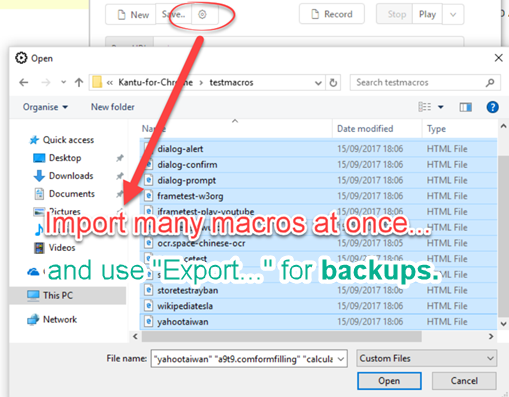
The UI.Vision RPA Selenium IDE github folio contains the /test folder with enough of test macros. You lot can download and import all macros/selenium IDE scripts at one time. For this, use the "Gear icon => Import HTML" feature and so select all the macros/scripts that you want to import (we call the test cases often macros - this is the same. We apply the word macros as some users use the extension not for web testing, only for spider web automation. There the word macro and macro recorder is very common.)
Top
Tip: Backup your macros
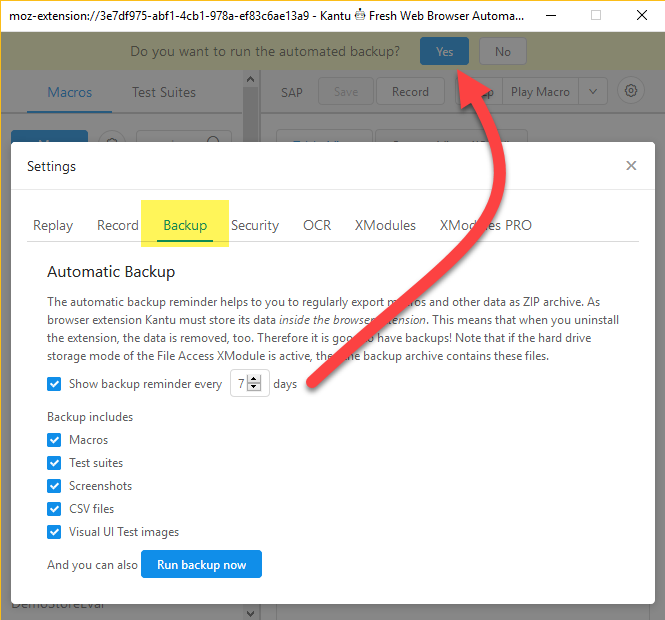
In the default storage way macros, test suites and all UI.Vision RPA settings are stored inside your web browser in what is called technically HTML5 local storage. Nothing is copied or moved to the deject. This ways that once y'all uninstall the UI.Vision RPA extension, your macros are gone! You tin use the "Export" feature to create backups of your of import test cases, CSV data and images. The fastest manner to export everything is to apply the "Run backup now" push button on the backup settings console. It exports all data at once.
If you need to recover data from a backup, see this forum post on how to restore macros from a backup.
Pinnacle
Command Line API
The control line API allows you to control all RPA features from any scripting or programming language. To start the RPA software via the command line you outset the browser (e. g. Chrome) via the command line and load the special RPA startup page. You can generate the page on the "API" settings tab. Information technology is always the same page, and then you only need to generate it once:
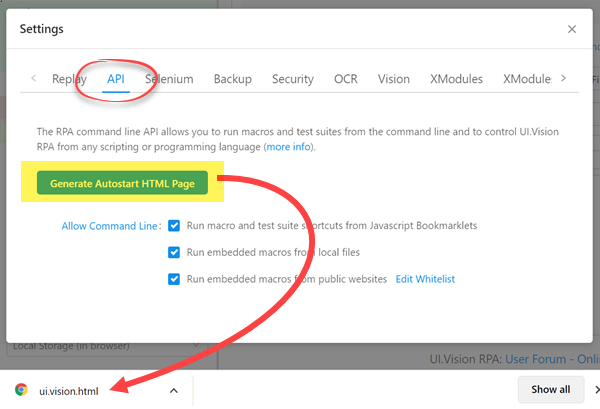
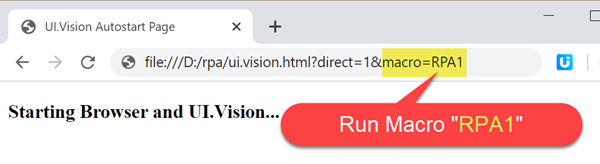
Then load the ui.vision.html website in the web browser and add ¯o=YourMacro - and the macro runs automatically! To skip the "Do y'all desire to run this macro?" question, add the "?direct=ane" switch to your local file URL (file:///...).
Important: Fifty-fifty so we mention the browser here, the command line feature works exactly the same in GUI desktop automation fashion. The browser and the local website are just needed considering the UI.Vision RPA cadre is technically implemented as browser extension. In other words, UI.Vision RPA can be used equally part of a CI pipeline for spider web automation and for desktop automation.
Allow UI.Vision RPA access to file URLs. This is just required in the Chrome and Edge browsers, since Firefox allows access to file URLs past default: 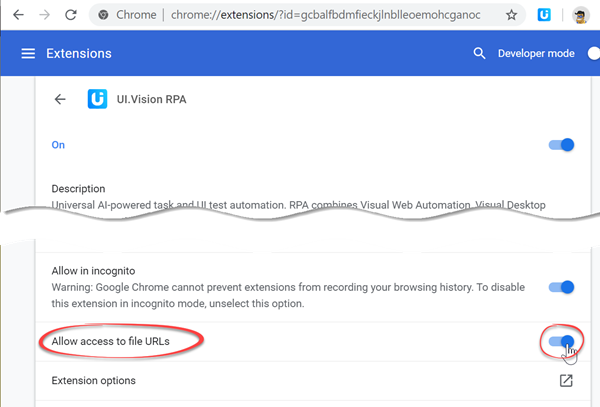
Case: A Windows batch file to run the RPA software from the control line on looks similar this:
"C:\Plan Files (x86)\Google\Chrome\Application\chrome.exe" "file:///D:/test/ui.vision.html?directly=1¯o=MyLogin&savelog=log1.txt"
The macro specified with macro=MyLogin is run. Note that yous must use file:/// for the file path. If you would just commencement with "C:\..." you will get a "file non found" error for the HTML file due to the appended "?straight=1¯o=MyLogin&closeRPA=1&savelog=log1.txt" GET parameters. Windows is used as an example here, the command line feature also works on Mac and Linux likewise. "ui.vision.html" is the exported launch page. IMPORTANT: Macro and Folder names are Instance-SENSITIVE.
A longer command line, this fourth dimension with Firefox:
"C:\Program Files\Mozilla Firefox\firefox.exe" "file:///D:/test/ui.vision.html?macro=demoframes&cmd_var1=hullo%21world&cmd_var2=123&cmd_var3=ABC&closeRPA=1&closeBrowser=i&straight=1&savelog=logfirefox.txt"
In this example nosotros apply the control line send some values to the macro and we close the RPA software and browser after the macro is done.
Command Line Demo Videos
CLI: Run 1 macro subsequently another with Powershell.
Using the command line API from Node.js
Control Line API Source Code
You find all source code on Github:
- - Batch file
- - Node.js
- - Powershell
- - Python file
- - VBS
UI.Vision RPA as Automator culling on Mac
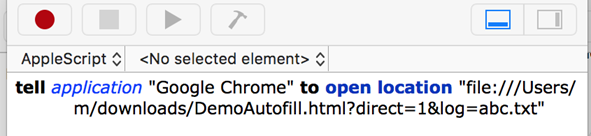
On MacOS you need to use AppleScript to start Chrome/Firefox with the file url. If y'all would only apply the Open up command, and then the Go parameters behind the ? are lost. You tin can go AppleScript executed from a bash script or role, or from a Terminal past just prefixing it with "osascript". So the correct command line syntax for Mac is
osascript -e 'tell application "Google Chrome" to open location "file:///Users/t/ui.vision.html?macro=Examination&direct=one&closeRPA=1&savelog=demotestlog.txt"'
Thanks to user Shunt/Timo for the forum post Launching UI.Vision RPA from Command Line on a Mac. Nosotros used their feedback to update this section.
Command Line Parameters
Note that in a strict technical sense these are not command line parameters, but "GET" parameters that are appended to the file URL of the "ui.vision.html" autorun HTML page that you lot are loading in the browser. But their purpose is simply like that of real command line parameters, so we call them this way.
- - direct=1 - Skip the "Do you lot want to run this macro?" question.
- - closeBrowser=1 - Closes the Chrome browser when the macro is completed. The default is "0", the browser remains open up. Screencast of a PowerShell script that uses CloseBrowser=0.
- - closeRPA=0 - Close UI.Vision RPA when the macro is completed. The default is "1", so UI.Vision RPA closes later the macro is done.
- - folder=foldername - exactly the same as the macro switch, merely information technology runs all macros inside a binder. This means every folder can exist used examination suite. Of import: Folder names are CASE-SENSITIVE.
- - savelog=filename.txt - This saves the log (content of the Log tab) plus a header condition header as a text file once the macro has completed. The log is saved whether the run was successful or non. The calling script (e. g. Batch file, Node.JS, Python, or PowerShell) can check for the existence of this file to brand sure the macro run completed). The first line of the log file is always the condition of the macro run (error or success, and the mistake message, if any).
A 2d way to save the log file is to use the command localStorageExport | log. Simply unlike the control line choice, this method does not add together a header with condition data to the meridian of the log. - - storage=browser/xfile - This parameter tells UI.Vision RPA if the macro or testsuite folder to run tin can be found in the HTML5 browser storage or on the hard bulldoze.
- - macro=folder1/subfolder1/macroname - Run the specified macro. IMPORTANT: Macro and binder names are Instance-SENSITIVE.
- - nodisplay=1 - Runs all macros in nodisplay style. A macro-internal !replayspeed setting overwrites this global value.
- - cmd_var1=hello%21world, cmd_var2, cmd_var3 - Send values to a UI.Vision RPA macro from the command line. Inside the macro you can access the value with the internal variables. ${!cmd_var1}, ${!cmd_var2} and ${!cmd_var3}.
- - Examples: All the above switches are used in the Control Line Source Code Snippets.
See also: You can non simply outset UI.Vision RPA from a script via the command line, you lot can as well start a script from within UI.Vision RPA with XRun.
Rarely used and deprecated control line options:
How to run UI.Vision RPA macros 24/7
Many applications of UI.Vision RPA require continuous operation of the software. Examples are the use of UI.Vision RPA as part of robotic process automation (RPA), extracting large volumes of information or web testing applications in full general.
Problem: By design web browsers are not intended for 24x7 operations and running them repeatedly for several days can lead to undesirable furnishings, such equally increased memory consumption ("retentiveness leaks").
Solution: The UI.Vision RPA control line allows y'all to control the UI.Vision RPA functioning. With the -savelog switch a calling script tin easily check on the success of each macro run. The -closebrowser and -closeRPA switches let you lot close Chrome and Firefox periodically to avoid retentivity leaks. And you can add code to terminate the Chrome or Firefox instances if they hang (eastward. g. using proc.impale() in Python or #taskkill /F /IM chrome.exe /T in Powershell).
Examples: Demo scripts for running UI.Vision RPA 24/7 are available in Github, see the Command Line Source Code Snippets paragraph.
Important: How to avoid extension auto-updates during unattended operation.
Related: How to run UI.Vision RPA with the Windows Task Scheduler
Tiptop
Running Concurrent Instances
You tin easily run concurrent instances of UI.Vision RPA with Chrome and Firefox via the command line. To exercise and then, you need to first each browser instance with its own profile. For Chrome the command line switch is -profile-directory="Contour 2" and for Firefox it is -p PROFILE_NAME.
Embed and run UI.Vision RPA macros in websites
Y'all tin embed macros directly into a website! This is a adept option if you lot need to distribute your macros to a larger numbers of users. Since UI.Vision RPA macros are in standard JSON format, it is very easy to create them dynamically eastward. thousand. from info within a database.
DEMO: This web page contains some embedded macros.
In order to run macros that are embedded in a website you have to first allow it . Y'all exercise this by checking the "Run embedded macros from public websites" box. This is step 1 in the screenshot beneath. The default setting is OFF (do not run embedded macros). In one case you let such macros in general, yous will run into a dialog box asking for permission to run such macros. If you want to avoid this warning dialog for certain websites (for example your own internal website), and then you lot tin add this website to the website whitelist (step two in the screenshot below):
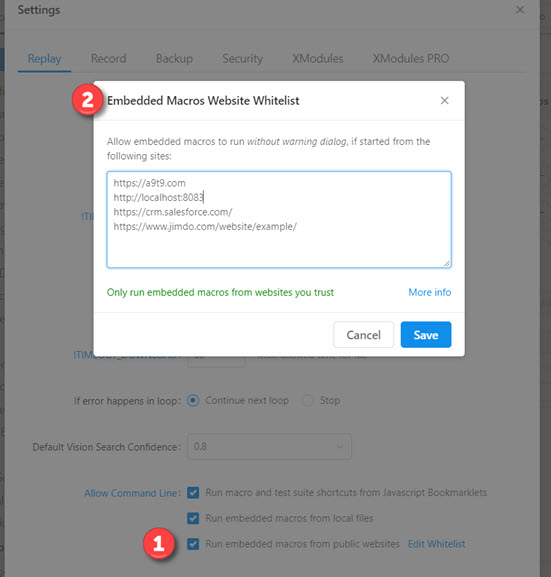
The URLs in the white list are the websites that tin can contain embedded macros, and that you want to run without alarm dialog.
Elevation
Run from bookmarks
In the macro context menu (right-click menu) select "Create bookmark". This adds a shortcut to the macro to your bookmarks. From now on you tin can just select the bookmark to run the macro. UI.Vision RPA will open up to run the macro and then close over again. But if the macro encounters an error, UI.Vision RPA stays open so you tin can meet what went wrong. 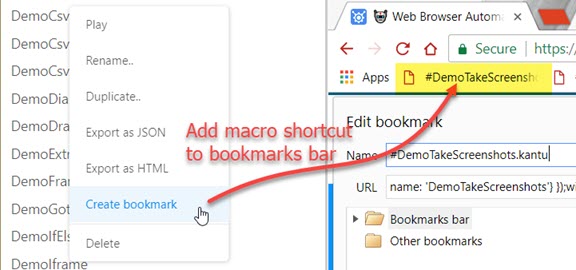
Technically UI.Vision RPA bookmarks are picayune Javascript snippets (bookmarklets) that start the UI.Vision RPA engine. And thus, like with all bookmarklets, they practice not piece of work on the Google Chrome and Firefox "New Tab" get-go page. For security reasons, the browser do not run any Javascript on this page. Only whenever a "normal" web page is loaded, the kantu web imacro bookmarks work great. 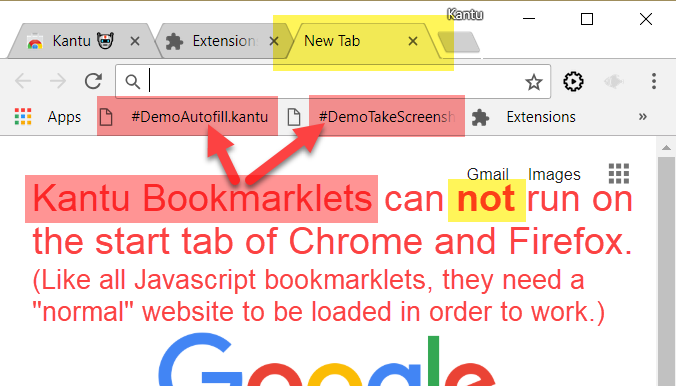
If you want to make sure Chrome and Firefox are in the foreground while the bookmark macro runs, add together the BringBrowsertoForeground command to your macro.
If you want to trigger your macros with keyboard shortcuts you can combine UI.Vision RPA'southward bookmarklets with the ShortKeys extensions .
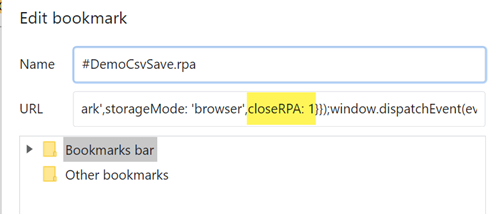
You tin modify the "shut UI.Vision RPA when macro is done" beliefs to "keep UI.Vision RPA open when macro is washed". To do so, edit the bookmark and change the flag closeRPA: one to closeRPA: 0 in the bookmarklet's Javascript lawmaking. Regardless of this flag, the UI.Vision RPA window stays open up if you manually press STOP during the macro run or if the macro stops with an fault.
Height
Password Encryption
UI.Vision RPA tin store passwords encrypted. Yous tin enable this feature and set a chief password in the settings.
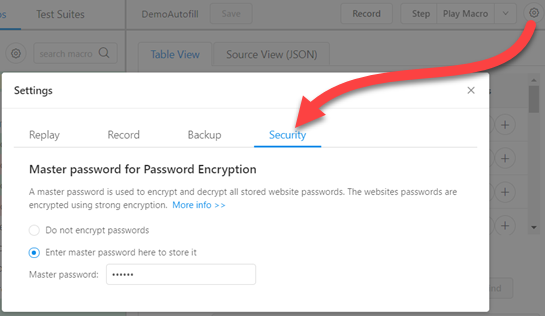
With the master password enabled, every website password that you enter during macro recording is non stored in plain text, but instead as an encrypted string. So instead of having a command similar
"Type | id=countersign | your-password-here"
the recorded command is
"TYPE | id=password | __KANTU_ENCRYPTED__f8b53105ebb186d...".
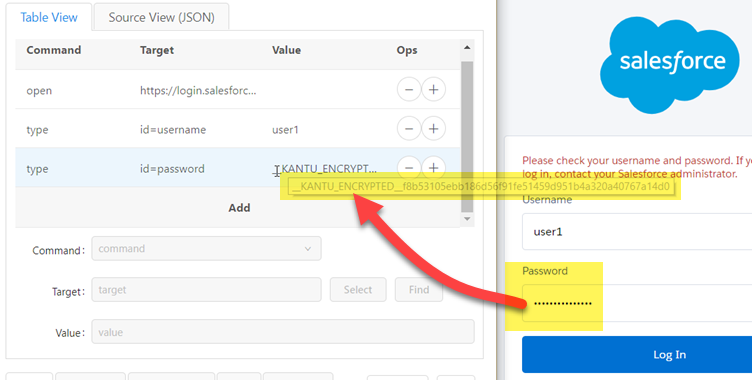
UI.Vision RPA uses 256-bit AES encryption which is considered unbreakable by security experts. Note that if you change the main password later, you need to re-record the password field, so that a new "__KANTU_ENCRYPTED__..." string is created.
Pinnacle
Test Suites V2.0 (Folders as Testsuites)
Since UI.Vision RPA V5.0 test suites are created on the macros tab, and not the test suites tab. The new concept is straightforward: Every folder is a test suite. To play a test suite, correct-click on a folder and select "Test suite: Play all macros in folder". To start the replay at a certain macro, right-click on the macro and select "Replay from hither".
You lot can add together or remove macros from a testsuite simply by adding or removing it from a folder. Macros in subfolders are ignored. The replay order is alphabetical, just similar the display social club.
To first a testsuite from the command line use the folder switch. This runs all macros in the binder.
Yous can use !GLOBAL_TESTSUITE_STOP_ON_ERROR to tell UI Vision to stop the test suite execution after an mistake. The default settings is "false", and then by default the RPA software continues to run all macros inside a test suite. Subsequently a test suite is washed, a examination report is displayed. It shows the pass/no pass status of each test (macro) and the detailed error messages.
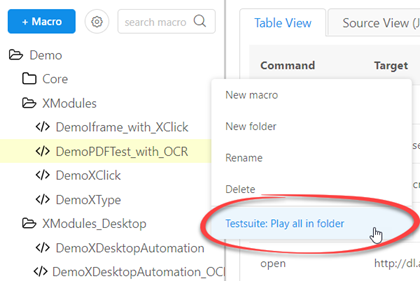
Every binder is now also a test suite. Only drag and drop macros in a folder to build a test suite.
Tip: Some other way to combine several macro (tests) into one is the RUN command.
Test Suites (Old-Way, Deprecated)
The former-style Test suites are created on the exam suites tab (deprecated) past selecting the test cases (macros) from the drop-down. Click the "+Macro" push button to add a new macro to the list. Y'all tin also specify how often each macro runs (loops). Test suites itself do not contain macro code, they contain the names of existing macros.
Starting with UI.Vision RPA Version five.3.10, the old way exam suites tab volition be hidden by default, when UI.Vision is fresh installed. But the test suites are not lost, just the tab is not displayed by default. Y'all can turn on the former-mode test suites tab in the Settings > Selenium > Checkbox (at the bottom).
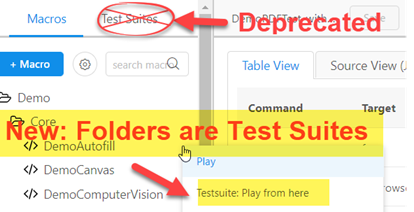
Old-style testsuites are still available for astern compatibility.
Once the test suite is completed, a exam written report summary is written to the log area. The success of each test case is also indicated visually.
To rearrange the society of the macros in the test suite and for other larger changes, we recommend to edit the JSON source directly. To edit it, either click the "hamburger icon" ☰ displayed to the right of the exam suite name, or right-click the test suite name and and so select "Edit source".
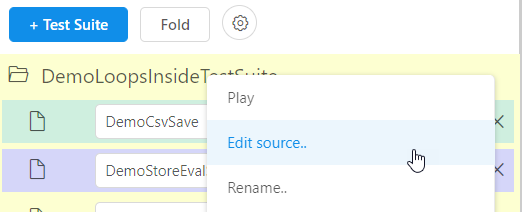
(DEPRECATED Old-STYLE TESTSUITE) One time you lot salve the edited source code, UI.Vision RPA runs a checks against all available macros to make sure there are no missing macros or typos.
Global Variables
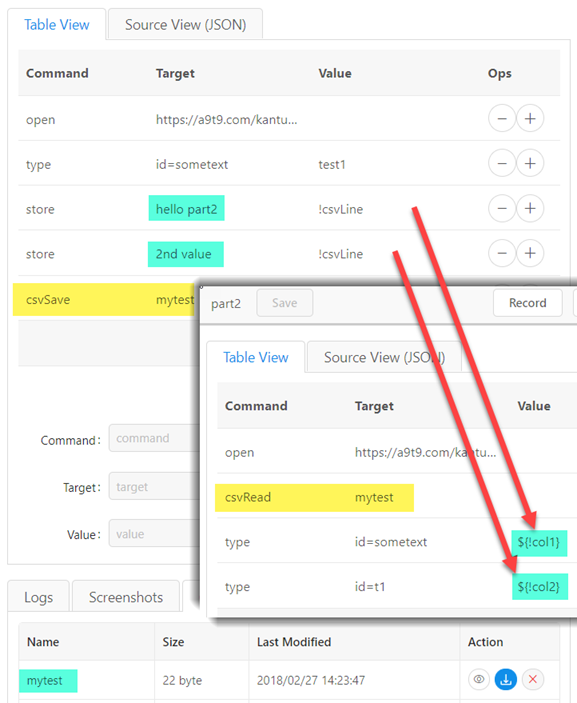
Global variables: Past default, each macro runs independent, no variables are shared. But you can create global variables that are available to every macro and examination suite simply by prefixing them with "Global..." (east. 1000. "globalMyCounter" or "GLOBAL_username"). In other words, variables whose name starts with "Global..." are shared . Global variables keep their value fifty-fifty after the macro has been stopped. Their content is but lost in one case UI.Vision RPA is closed.
If you want your data to survive a closing of Kantu, then shop ("persist") information technology in a CSV file with csvSave and csvRead:
Height
Security and Privacy
The UI Vision RPA core is open-source and guarantees Enterprise-Course Security. Your data never leaves your machine.
For developers
The source lawmaking of the UI.Vision RPA core is available on GitHub (License: GNU).
For the adjacent update(s): Beta Testers wanted!

We run our own QA, only our exam automation tin never cover the amazing variety of UI.Vision RPA use cases and ideas that UI.Vision RPA users have come with. This beta program helps us to brand sure that a new release does not inadvertently break existing macros. So please consider joining our beta version announcement list.
Meridian
wingfieldhinagesphe.blogspot.com
Source: https://ui.vision/rpa/docs
0 Response to "Read a Csv File and Display on Ui in C#"
Enviar um comentário