Should You Let 2 Week Old Baby Sleep a Lot
© 2008 – 2017 Gwen Dewar, Ph.D., all rights reserved
As every parent knows, the world of newborn sleep is exotic and strange. Babies rack up lots of sleep overall, averaging xvi-18 hours a twenty-four hour period during the outset two weeks. Yet they awaken frequently, and rarely sleep more than 4 hours at a stretch, even at night. Their internal clocks aren't yet synchronized with the external, 24-hour day.

Information technology's a recipe for exhaustion, but understanding the scientific discipline of slumber can help yous cope, and avoid mistakes that can delay your kid'due south development of more mature sleep rhythms.
In this article, you'll larn about
- cardinal differences between newborn sleep and adult sleep;
- circadian rhythms, and how you can aid your baby become in sync with the natural day;
- sleep cycles in the newborn, and how to piece of work around them;
- tips for preventing newborns from waking up; and
- advice for improving your own sleep.
Throughout, I focus on babies under four weeks of age. For information virtually older infants, see my article on opens in a new windowbaby sleep patterns.
If yous are looking for data nigh opens in a new windownewborn slumber condom, see these science-based tips for reducing the adventure of SIDS.
Newborn sleep patterns: Are there whatsoever?
To the sleepless parent, newborn sleep might seem totally disorganized. For example, consider these points.
1. Newborns never sleep for long.
Newborns sleep in short bouts — typically ranging from 30 minutes to 4 hours — at seemingly random times throughout the mean solar day and night.
two. Newborns awaken easily.
In role, this is because they spend a large portion of their sleep time in "agile sleep," a lite slumber state characterized by fluttering eyelids; rapid, irregular animate; occasional body movements; and vocalizations (grunts or brief cries).
3. Newborn sleep times tin vary widely.
In the starting time few days, the average newborn sleeps between 16-18 hours a day (Iglowstein et al 2002). By four weeks, newborn sleep averages about fourteen hours. But the range is considerable. Some four-calendar week-old babies sleep as niggling as 9 out of 24 hours. Others sleep for xix hours a day (Iglowstein et al 2002).
If your infant doesn't fit the typical contour, does that mean something is wrong?
Not necessarily. Some babies endure from medical conditions that influence the way they slumber, so if you accept concerns you lot should talk over them with your medical provider. Just information technology appears that many salubrious, normal newborns deviate several hours from the average elapsing of sleep.
Newborn sleep rhythms: Why newborns seem to slumber—and wake—around the clock

The timing of adult sleep is governed by circadian rhythms — physiological changes that follow a 24-hour cycle. Many of these changes are influenced by your exposure to light.
For instance, when y'all expose yourself to sunlight during the twenty-four hour period, y'all are helping your torso calibrate it's internal clock. Even if you are sleep-deprived, morning low-cal helps ensure that you will exist more alert during the mean solar day than you lot are at night.
Conversely, the absence of light at night helps your body air current down. When darkness falls, your brain interprets this equally a bespeak to start producing melatonin, a hormone that triggers relaxation, paving the way for sleep.
You can easily disrupt this process by exposing yourself to artificial light sources in the evening — peculiarly sources of blue lite (Wahnschaffe et al 2013). But every bit long as you stick with the program — bright light during the day, and darkness at night — you lot will probable find yourself in sync with the natural, 24-hour mean solar day.
And of course near adults are in sync. But it'due south different for newborns.
Newborn sleep is not governed by strong circadian rhythms.
Things don't begin that way. Not when babies are still in the womb. During pregnancy, fetuses are tuned into their mothers' physiological cues about day and night.
Fetal heart and respiratory rates speed upwardly when a mother is active. They tiresome downwardly when a female parent is sleeping (Mirmiran et al 2003). Such changes may exist influenced past maternal hormones, peculiarly melatonin. Maternal melatonin passes through the placenta, and may straight the fetus' internal clock (Torres-Farfan et al 2006).
But later on birth, this intimate hormonal connection is broken. Newborns must develop their ain circadian rhythms of hormone production.
Unfortunately for us, this takes fourth dimension (Kennaway 1996), and the process is complicated past the fact that newborns demand to feed every few hours. As a result, newborn sleep episodes tend to exist brief, and spaced at fairly regular intervals around the clock.
And then when do babies develop mature circadian rhythms?
It's normal for babies to take 12 weeks, or even longer.
Nearly infants take about 12 weeks to bear witness day-night rhythms in the production of melatonin (Rivkees 2003). Circadian changes in cortisol, a hormone that helps regulate alacrity, may have even longer to emerge (Rivkees 2003). And, overall, babies may take 3-5 months earlier they "settle" at night–pregnant that they sleep for more than 5 hours at a stretch (Jenni et al 2006; Pinilla and Birch 1993).
Nevertheless, newborn sleep isn't completely divorced from the natural rhythms of the 24-hr mean solar day. Studies testify that cyclic rhythms brainstorm developing in the commencement days later birth.
For example, German language and Japanese studies have reported that newborns sleep more than at nighttime than they practise during the twenty-four hour period (Freudigman and Thoman 1998; Korte 2004; Matsuoka et al 1991).
And scientific bear witness suggests that even newborns are receptive to ecology cues about time. Yous tin can have advantage of this fact to help shape newborn sleep patterns.
How to assist newborns get in sync with the natural, 24-hour twenty-four hours
1. Brand your babe a role of your daily routine.
When parents include their newborns in their daily activities, newborn may adapt more quickly to the 24-hour day (Custodio et al 2007; Lorh et al 1999).
One written report took continuous measurements of mother-infant activity patterns for four months after birth. Newborns who were active at the same fourth dimension of day equally their mothers were quicker to develop mature circadian rhythms (Wulff and Siegmund 2002).
2. Reduce stimulation at night.
When your baby wakes for dark time feedings, keep activity to a minimum. Make as fiddling noise as possible, and avoid moving your infant effectually. Ideally, y'all want to avoid waking her "all the way upwardly." But if that isn't possible, at least try to minimize the hustle and bustle. You desire the babe to acquire that nighttime is for sleep and quiet.
3. Expose your newborn to natural lighting patterns.
Light cues might not instantly synchronize newborn sleep patterns, simply they help.
For example, in 1 study, newborns slept longer at night if their parents observed a regular policy of turning out the lights by 9pm (Iwata et al 2017).
In some other study, young babies tended to slumber longer at night if they had been exposed to lots of early afternoon light (Harrison 2004).
And time spent outdoors might make an important difference. Babies who go outside experience much higher daytime lite levels than those kept indoors all day, and may develop stronger circadian rhythms equally a outcome (Tsai et al 2012).
4. T ry babe massage.
A recent experiment constitute that mothers assigned to massage their newborns with lotion at bedtime experienced ameliorate newborn sleep outcomes than mothers who massaged without lotion and mothers in a control group who didn't massage at all.
After one month, newborns massaged with lotion were falling asleep faster, staying asleep longer, and awakening at night less ofttimes. Mothers using lotion actually massaged their infants more frequently, which may explain the results (Field et al 2016). An earlier study found that babe massage helped newborns develop more mature patterns of melatonin secretion (Ferber 2002).
The takeaway? More research is needed on this topic (Bennett et al 2013), but meanwhile, this seems worth a try.
v. Exercise you pump and store breast milk? Consider keeping a record of what time of day you lot express.
Breast milk contains tryptophan, an amino acid that is used by the body to manufacture melatonin. Tryptophan levels rising and autumn according to maternal cyclic rhythms, and when infants swallow tryptophan before bedtime, they fall comatose faster (Steinberg et al 1992).
It's therefore possible that breastfeeding helps newborn slumber patterns synchronize with the 24-hour 24-hour interval (Cubero et al 2005). This hypothesis was tested by feeding infants formula fortified with varying concentrations of tryptophan. When infants were given low levels of tryptophan during the twenty-four hour period and high concentrations at night (mimicking the natural fluctuations of breast milk), infants fell comatose faster at night and got more slumber overall (Cubero et al 2007).
Newborn sleep cycles: Why newborns are light sleepers
When adults first fall asleep, nosotros pass through a couple of light sleep stages, and then plunge into a bout of deep sleep.
Afterwards, we switch into REM, or "rapid eye movement" sleep, a sleep stage famous for its association with dreaming, and the loss of musculus tone. We don't motility much during REM.
When REM is over, we either awaken, or render to light sleep and begin the cycle again. For the boilerplate adult, a unmarried sleep cycle lasts about xc-100 minutes. We may partially awaken many times during the night. Simply nosotros're more than likely to wake upwardly "all the style" during transitions between stages, during light sleep, and during REM.
Newborn slumber is also characterized by sleep stages and cycles, only there are crucial differences.
Start, babies typically begin their slumber bouts in the newborn equivalent of REM (sometimes called "agile sleep").
Second, newborns in REM don't ordinarily experience muscle atonia.
Different us, they may thrash around, stretch, twitch, and even vocalize. The results tin fool parents into thinking their babies are waking up, when they are actually experiencing normal REM slumber.
Third, newborn slumber cycles are shorter — around fifty-55 minutes for the average infant — and REM makes up a much bigger proportion of slumber.
It's not unusual for newborns to spend more than half their full sleep time in REM (Grigg-Damberger 2016). Indeed, several studies suggest that, over the class of a 24 hour 24-hour interval, some newborns spent may spend every bit much as 75% of their slumber time in active sleep (e.g., Poblano et al 2007; Sadeh et al 1996).
Fourth, while newborns do experience something roughly analogous to deep sleep, this stage, chosen "repose sleep," is potentially unsafe.
Characterized by slower, more than rhythmic breathing, placidity sleep appears more restful (Grigg-Damberger 2016). But it's harder for babies to awaken from repose sleep, which can cause problem if the baby isn't getting enough oxygen.
This may explain why newborns don't oblige exhausted parents past lapsing into long periods of deep slumber. Information technology'south too risky. Instead, the typical 50-55 minute newborn sleep cycle includes only nigh 20 minutes of quiet sleep. The rest of the time, babies are either in REM or in "transitional slumber," a rather restless state that looks like a brew-upward of active and quiet sleep, and which scientists don't yet sympathise (Grigg-Damberget 2016).
Put this all together, and you can run into why parents feel their babies are such light (and erratic) sleepers. Like adults, newborns are more likely to awaken during REM, and during transitions between sleep stages. Only unlike adults, newborns spend a lot more time in REM, and they transition between cycles more frequently.
And parents may sometimes fault REM restlessness for waking — and attempt to interact with or soothe a baby at the wrong fourth dimension. In brusque, there are lots of opportunities for babies to wake upwards — or get awakened unnecessarily.
This sounds like a raw deal for parents. Simply newborns probably benefit from being light sleepers. opens in a new windowHaving a low threshold of arousal may protect babies from SIDS, and active sleep might be crucial for a newborn'south brain development (Heraghty et al 2008; Seigel 2005).
And if we understand the peculiar nature of newborn REM, we tin larn to avoid jumping in as well soon when nosotros think a baby is awakening or signalling for usa.
A baby who seems to be waking up may, if left lonely, go back to slumber very rapidly.
How to keep your calorie-free sleeper from waking up all the way
i. Don't blitz in the moment you retrieve your baby has awakened.
As noted to a higher place, babies experience frequent arousals, just that doesn't mean they are doomed to wake up "all the fashion" every few minutes. Babies oft jerk, sigh, or vocalize during partial arousals. If you avoid stimulating them during these moments, they may go dorsum to slumber on their own.
2. Tank up the babe before yous go to sleep.
Whether you breastfeed or bottle-fed, try to requite the babe an particularly large meal before your own bedtime. This will encourage your baby to sleep longer. To learn more than nearly this approach, see this Parenting Science guide to opens in a new window"Dream feeding."
iii. If yous feed your baby formula, endeavour to find one that includes DHA.
DHA is a fatty acid institute in fish oil and other dietary sources. It's important for encephalon development, and may play a role in shaping sleep patterns besides.
In i study, children who consumed depression levels of DHA had reduced corporeality of slow-moving ridge (deep) sleep (Faglioli et al 1989). In another study, pregnant women with higher claret levels of DHA gave nascency to babies who spent more time in quiet slumber (Cheruku et al 2002).
DHA is found in chest milk, and so it's plausible (though unproven) that boosting a nursing female parent'south DHA intake could ameliorate a newborn's sleep patterns. If you use formula, it seems similar a expert thought to find a baby formula that contains DHA.
4. Check out my article on opens in a new window baby slumber aids.
There yous'll observe tips for improving newborn sleep, and fugitive practices that are either unhelpful or potentially hazardous.
What well-nigh you lot? Tips for improving your own sleep
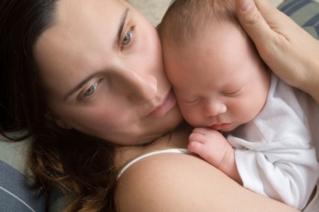
Newborn sleep patterns accept their toll on parents. In a study tracking the slumber patterns of mothers from pregnancy through the postpartum period, maternal slumber worsened subsequently childbirth and continued to deteriorate until about 12 weeks postpartum (Kang et al 2002)—-the fourth dimension when newborn sleep patterns begin to show marked circadian rhythms (Nishihara et al 2000).
Twelve weeks isn't forever, but it tin can seem like it when you are severely sleep restricted. As you struggle to cope with newborn sleep patterns, don't forget to look after yourself. Here are some tips to help you cope.
i. Appreciate the power of a thirty-minute nap
When you're running upward an enormous sleep debt, you might think a xxx-minute nap will brand little difference to your health.
Merely contempo research confirms that all naps are not the same. When you lot're sleep deprived, the brain compensates past rendering naps more restorative than usual.
In one study, volunteers permitted to sleep only 2 hours at dark showed the typical abnormalities in their stress hormone and immune factor chemical science. Just after just two 30-infinitesimal naps, those irregularities were entirely normalized (Faraut et al 2015b).
In another study, volunteers coping with a 2-hour nightly regimen experienced heightened hurting sensitivity — a common symptom of sleep impecuniousness. But in one case once again, the effect was reversed after just two 30-minute naps (Faraut et al 2015a).
two. Don't assume that it'southward pointless to lie down if y'all don't fall asleep. Y'all might pass into a land of drowsy, semi-witting sleep — and reap some benefits.
Too wired to "slumber when the infant sleeps"? If so, go on in mind that placidity resting is ameliorate than nothing. In fact, if you lot are lying downwards with your eyes closed, yous might be asleep without realizing it.
In numerous lab studies, subjects who were awakened from the commencement stage of sleep frequently denied that they were asleep at all (Dement and Vaughan 1999). A nap that consists merely of stage 1 sleep might not help you ameliorate your reaction times, but it will probably make you experience less tired. And if yous manage to sideslip into the second stage of sleep — fifty-fifty for simply 3 minutes — your nap may have recuperative effects (Hayashi et al 2005).
3. Don't play the blame game.
Brooding about the situation volition make it harder for you to fall asleep when you are given the opportunity. And it's wrong-headed, too: You lot might be doing everything yous tin can to get more slumber, and withal exist stuck with a baby who sleeps less than average.
Research suggests that the amount of sleep we get at night is strongly influenced past genetics (Touchette et al 2013), and, as mentioned above, there is a lot of individual variation among newborns.
4. Don't assume that breastfeeding volition make you more sleepless than formula feeding.
One report reported that the parents of breastfed babies averaged 40-45 minutes more than sleep time than did the parents of formula-fed babies (Doan et al 2007).
v. If y'all are breastfeeding, you are likely to become more sleep if you lot keep your infant nearby.
The World Health Organization recommends that babies share a bedroom with their parents, and information technology's a recommendation that makes breastfeeding less disruptive. A recent study found that breastfeeding women got more slumber when they co-slept with infant (Quillin and Glenn 2004). In fact, mothers who co-slept and breastfed got more sleep than did mothers who bottle-fed their babies (Quillin and Glenn 2004).
6. If your baby is asleep, don't worry about changing diapers.
If your infant can't sleep because she needs a diaper change, she'll let you know. And a niggling urine is unlikely to awaken her anyway. In a recent experiment, researchers injected h2o into the diapers of sleeping infants to see if this would wake them upward (Zotter et al 2007). Information technology didn't.
seven. Get sunlight and avoid artificial lighting at night.
Make sure you expose yourself and your baby to brilliant lite during the day. And keep lights out–or at least dimmed–after sunset.
As noted above, natural lighting helps influence newborn sleep patterns. But it too helps you keep your own circadian rhythms from drifting, which is important if you are going avoid insomnia and be a source of daytime cues for your newborn.
eight. Let a friend or family member sentinel your baby while you take a nap, even if this means your breastfed infant will take some meals from a bottle.
Lactation experts oftentimes discourage breastfeeding mothers from canteen feeding babies for the start iii-4 weeks. The worry is that supplemental feeds will atomic number 82 to a decreased milk supply and endanger successful breastfeeding in the long-term.
Simply y'all need to balance this confronting the negative furnishings of severe sleep brake. Lack of sleep puts parents at increased risk of illness and opens in a new windowpostpartum depression, which is bad for parents and babies. If yous are at the stop of your rope, get help.
9. Trust your instincts, and get help when you feel stressed
If something feels wrong with you or the baby, talk to your md. And retrieve that your own mental health is crucial.
Coping with slumber impecuniousness is very stressful, especially if your babe opens in a new windowseems to exist especially fussy or prone to crying. Scout for signs of opens in a new windowpostpartum stress and opens in a new windowpostpartum depression, and attain out to others for support.
10. Call back that things volition become better
Newborns take special sleep patterns and special needs. Simply things will start to get ameliorate around 12 weeks postpartum.
More reading relevant to newborn slumber
For more information about babies and slumber, meet opens in a new windowthese fully-referenced Parenting Scientific discipline manufactures.
References: What scientific studies say nigh newborn slumber
Anders TF. 1979. Night-waking in infants during the first year of life. Pediatrics 63: 860-864.
Bennett C, Underdown A, and Barlow J. 2013. Massage for promoting mental and physical health in typically developing infants nether the age of vi months. Cochrane Database Syst Rev. 2013 Apr xxx;4:CD005038. doi: 10.1002/14651858.CD005038.pub3.
Cheruku SR, Montgomery-Downs HE, Farkas SL, Thoman EB, and Lammi-Keefe CJ. 2002. Higher maternal plasma docosahexaenoic acid during pregnancy is associated with more mature neonatal sleep-state patterning. Am J Clin Nutr 76:608-13.
Cubero J, Valero 5, Sánchez J, Rivero M, Parvez H, Rodríguez AB, Barriga C. 2005. The circadian rhythm of tryptophan in breast milk affects the rhythms of 6-sulfatoxymelatonin and slumber in newborn. Neuro Endocrinol Lett. 26(half dozen):657-61.
Cubero J, Narciso D, Terrón P, Rial R, Esteban S, Rivero M, Parvez H, Rodríguez AB, Barriga C. 2007. Chrononutrition applied to formula milks to consolidate infants' sleep/wake cycle. Neuro Endocrinol Lett. 28(4):360-6.
Custodio RJ, Junior CE, Milani SL, Simões AL, de Castro M, Moreira Air-conditioning. 2007. The emergence of the cortisol circadian rhythm in monozygotic and dizygotic twin infants: the twin-pair synchrony. Clin Endocrinol (Oxf). 66(2):192-7.
Dement W and Vaughan C. 1999. The hope of sleep. New York: Random House.
Doan T, Gardiner A, Gay CL, Lee KA. 2007 Breast-feeding increases sleep duration of new parents. J Perinat Neonatal Nurs. 21(3):200-6.
Faglioli I, Barconcini P, Ricour C, and Salzarulo P. 1998. Subtract of dull-wave sleep in children with prolonged absence of essential lipids intake. Sleep 12: 495-499.
Faraut B, Léger D, Medkour T, Dubois A, Bayon V, Chennaoui M, Perrot S. 2015a. Napping reverses increased pain sensitivity due to sleep restriction. PLoS One. 10(2):e0117425.
Faraut B, Nakib South, Drogou C, Elbaz M, Sauvet F, De Bandt JP, Léger D. 2015b. Napping reverses the salivary interleukin-vi and urinary norepinephrine changes induced past slumber restriction. J Clin Endocrinol Metab. 100(iii):E416-26.
Ferber SG, Laudon M, Kuint J, Weller A, Zisapel Northward. 2002. Massage therapy past mothers enhances the adjustment of circadian rhythms to the nocturnal period in total-term infants. J Dev Behav Pediatr. 23(6):410-5.
Field T, Gonzalez M, Diego Thousand, Mindell J. 2016. Mothers massaging their newborns with lotion versus no balm enhances mothers' and newborns' sleep. Babe Behav Dev. 45(Pt A):31-37.
Freudigman KA and Thoman EB. 1998. Infants' earliest slumber/wake organization differs as a function of delivery way. Dev Psychobiol. 32(4):293-303.
Grigg-Damberger MM. 2016. The Visual Scoring of Slumber in Infants 0 to 2 Months of Age. J Clin Sleep Med. 12(3):429-45.
Iglowstein I, Jenni OG, Molinari L, Largo RH. 2003. Slumber duration from infancy to boyhood: Reference values and generational trends. Pediatrics 111(2): 302-307.
Harrison Y. 2004. The relationship between daytime exposure to light and night-fourth dimension slumber in 6-12-week-old infants. J Sleep Res. 13(four):345-52.
Hayashi M, Motoyoshi Due north, Hori T. 2005. Recuperative power of a brusk daytime nap with or without stage 2 sleep. Sleep. 28(7):829-36.
Heraghty JL, Hilliard TN, Henderson AJ, and Fleming PJ. 2008. The physiology of sleep in infants. Arch Dis Kid. 2008 Nov;93(11):982-5.
Horne RSC, Parslow PM, Ferens D, Watts AM, and Adamson TM. 2004. Comparison of evoked arousability in breast and formula fed infants. Arch Dis Child 89: 22-25.
Hugelin A. 1982. Mechanisms of respiratory command during sleep and wakefulness: implications in newborn sleep apnoea. Electroencephalogr Clin Neurophysiol Suppl. 36:625-30.
Iwata S, Fujita F, Kinoshita G, Unno M, Horinouchi T, Morokuma S, Iwata O. 2017. Dependence of nighttime sleep duration in one-month-sometime infants on alterations in natural and artificial photoperiod. Sci Rep. 7:44749.
Jenni OG, DeBoer T, and Acherman P. 2006. Development of the 24h rest-activeness pattern in human infants. Babe behavior and development 29: 143-152.
Kang MJ, Matsumoto Grand, Shinkoda H, Mishima Chiliad, Yeo YJ. 2002. Longitudinal study for sleep-wake behaviours of mothers from pre-partum to post-partum using actigraph and sleep logs. Psychiatry Clin Neurosci. 56(3):251-2.
Kato I, Franco P, Grosswasser J, Scaillet S, et al. 2003. Incomplete arousal processes in infants who were victims of sudden decease. Am J Respir Crit Care Med 168: 1298-1303.
Kennaway DJ, Goble FC and Stamp GE. 1996. Factors influencing the development of melatonin rhythmicity in humans. Journal of Clinical Endocrinology & Metabolism, Vol 81, 1525-1532
Korte J, Hoehn T, Siegmund R. 2004. Actigraphic recordings of activity-rest rhythms of neonates born by different delivery modes. Chronobiol Int. 21(one):95-106
Lohr B, Siegmund R. 1999. Ultradian and circadian rhythms of slumber-wake and nutrient-intake behavior during early on infancy. Chonobiology international 16(ii): 129-148.
Matsuoka Yard, Segawa Yard, and Higurashi M. 1991. The Development of Sleep and Wakefulness Cycle in Early Infancy and Its Relationship to Feeding Habit. The Tohoku Journal of Experimental Medicine 165 (2):147-154.
McNamara F, Lijowska Every bit, and Thach BT. 2002. Spontaneous arousal action in infants during NREM and REM sleep. J Physiol 538: 263-269.
Mirmiran M, Maas YG, Ariagno RL. 2003. opens in a new windowDevelopment of fetal and neonatal sleep and cyclic rhythms. Sleep Med Rev. vii(4):321-34.
Nishihara K, Horiuchi South, Eto H, Uchida S. 2000. The evolution of infants' cyclic rest-activity rhythm and mothers' rhythm. Psychiatry Clin Neurosci. 54(3):305-6
Pinilla T and Birch LL. 1993. Help me make it through the nighttime: Behavioral entrainment of breasfed infants' slumber patterns. Pediatrics 91: 436-444.
Poblano A, Haro R, and Arteaga C. 2007. Neurophysiologic measurement of continuity in the slumber of fetuses during the last calendar week of pregnancy and in newborns. Int J Biol Sci. iv(ane):23-8.
Quillin SI and Glenn LL. 2004. Interaction betwixt feeding method and co-sleeping on maternal-newborn sleep. J Obstet gynecol Neonatal Nurs 33(5): 580-588.
Rivkees SA, Mayes L, Jacobs H, Gross I. 2004. Rest-action patterns of premature infants are regulated past cycled lighting. Pediatrics. 113(four):833-9.
Sadeh A, Dark I, and Vohr BR. 1996. Newborns' sleep-wake patterns: the part of maternal, commitment and infant factors. Early Hum Dev. 44(2):113-26
Siegel JM. 2005. Functional implications of slumber development. PLoS Biology 3(5): 756-758.
Thomas KA and Burr R. 2002. Preterm baby temperature circadian rhythm: possible effect of parental cosleeping. Biol Res Nurs. 3(3):150-9.
Torres-Farfan C, Rocco V, Monsó C, Valenzuela FJ, Campino C, Germain A, Torrealba F, Valenzuela GJ, and Seron-Ferre K. 2006. Maternal melatonin effects on clock gene expression in a nonhuman primate fetus. Endocrinology. 147(10):4618-26.
Touchette East, Dionne G, Forget-Dubois N, Petit D, Pérusse D, Falissard B, Tremblay RE, Boivin Thousand, and Montplaisir JY. 2013. Genetic and ecology influences on daytime and night slumber duration in early childhood. Pediatrics 131(vi):e1874-lxxx.
Tsai SY, Thomas KA, Lentz MJ, Barnard KE.2012. Low-cal is beneficial for baby circadian entrainment: an actigraphic written report. J Adv Nurs. 68(8):1738-47.
Van Sleuwen BE, Englelberts AC, Boere-Boonekamp MM, Kuis W, Schulpen TWJ, and Fifty'Hoir MP. 2007. Swaddling: A systematic review. Pediatrics 120: e1097-1106.
Wahnschaffe A, Haedel S, Rodenbeck A, Stoll C, Rudolph H, Kozakov R, Schoepp H, and Kunz D. 2013. Out of the lab and into the bathroom: evening brusque-term exposure to conventional low-cal suppresses melatonin and increases alacrity perception. Int J Mol Sci. 14(2):2573-89.
Wulff K, Siegmund R. 2002.[Emergence of circadian rhythms in infants before and subsequently birth: prove for variations by parental influence]. Z Geburtshilfe Neonatol. 206(5):166-71. Review. German.
Zotter H, Urlesberger B, Pichler K, Mueller Westward, Kerbl R. 2007. Do moisture diapers induce arousals in sleeping infants? Acta Paediatr. 96(3):452-3.
Content of "Newborn sleep patterns" final modified nine/17
Epitome credits for "Newborn slumber patterns"
title imagine of newborn sleeping by Raw pixel / istock
epitome of mother kissing newborn ©iStockphoto.com/Shawn Gearhart
paradigm of tired mother with sleeping newborn by istock
wingfieldhinagesphe.blogspot.com
Source: https://parentingscience.com/newborn-sleep/
0 Response to "Should You Let 2 Week Old Baby Sleep a Lot"
Enviar um comentário