Making College Free Again Se Smith
Smith'southward Pronoun Problem
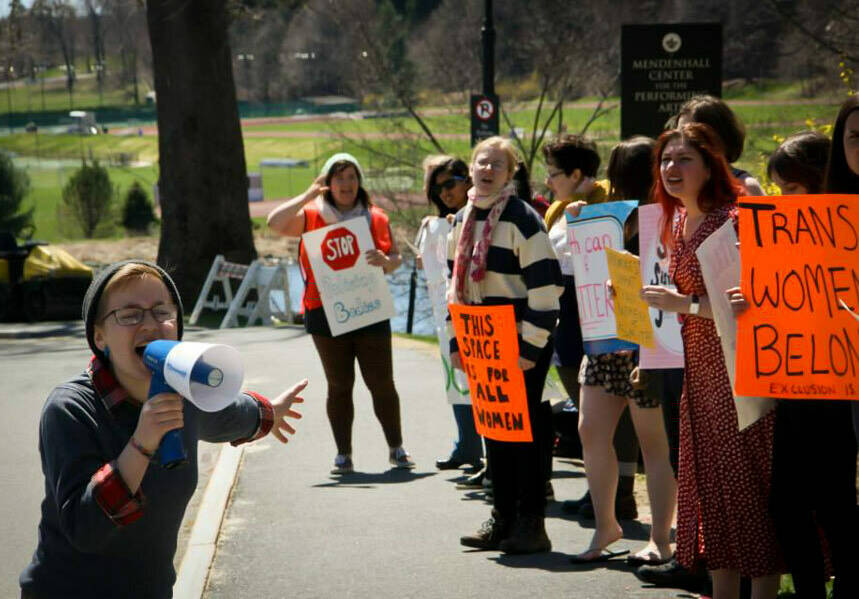
Students protest the school's admissions policies regarding trans women.
Jude Ellison Sady Doyle
Reader donations, many as small equally simply $5, are what fund the piece of work of writers similar this—and continue our content costless and accessible to everyone. If you back up this work, will you lot chip in to help fund it? Information technology merely takes a minute to donate. Click here to make a tax-deductible donation.
In April, dozens of students at the all-women'due south Smith College in Northampton, Massachusetts, rallied outside the white Colonial building that houses the schoolhouse's admissions role. They were in that location to protestation an admissions policy that they say discriminates against trans women. The action not just put pressure on Smith to become a more than welcoming place for trans students, only also reignited a very former debate nigh transgender issues and "adult female-but" spaces.
'The administration has made information technology abundantly articulate that they have fabricated all the changes they desire to, even when a trans adult female student specifically explained that what they are doing is excluding women from a 'feminist' institution.'
This is an established sore spot for Smith. While the schoolhouse's website says that "an awarding from a transgender educatee is treated no differently from other applications," in 2013 a transgender woman named Calliope Wong had her application rejected, twice, on the grounds of her sexual practice. On Wong'southward blog, she wrote that the admissions department initially told her that if she was referred to past female person pronouns in the standard awarding materials — high school transcript, three letters of recommendation and optional standardized test scores — she would be eligible for admission. So her application was denied because her high school transcript described her as "male." After working with her school to alter the transcript and re-apply, she was rejected again, based on her FAFSA application, which also described her every bit male person.
Wong posted to her web log a photo of her final rejection letter from Dean of Admission Debra Shaver, which included the line, "Smith is a women's college, which ways that undergraduate applicants to Smith must be female at the fourth dimension of admission."
The situation raised substantial outcry. In response, Smith said it would no longer have into consideration gender markers on financial-aid forms. Even so, the schoolhouse's "Gender Identity and Expression" policy still reads, "Smith expects that, to be eligible for review, a student's awarding and supporting documentation (transcripts, recommendations, etc.) volition reverberate her status as a adult female."
This, opponents of the policy argue, paves the way for the same transcript problems that plagued Wong the start time around. It also displays an ignorance of the barriers facing transgender women. Our lodge currently assigns babies a gender at nascency, stamping them as officially Grand (male) or F (female) simply a few hours into their life, based on the shape of their genitalia, before they get to accept whatever say on the thing. A person'south legal documentation, given name and, yes, school records, volition reverberate that assigned gender throughout her life, unless she goes through the process of officially changing them. For cisgender people, who grow up to place with their assigned gender, this doesn't pose a trouble. But transgender people realize — often very early on in life — that their assigned gender doesn't reverberate their actual gender identity. A transgender woman, for case, is a woman who was assigned "M" on her nativity certificate; a transgender man, vice versa. Some trans people place as not-binary or genderqueer or a host of other identities that don't fit into the two established "male" and "female" categories.
The issue of documentation can be a lifelong struggle for transgender women. According to transgender abet and author Katherine Cross, "in well-nigh parts of the U.s.a., ensuring that all of your documents 'consistently place' you lot every bit female requires a surgery that costs at least $18,000." She notes that some states bar irresolute the gender on a birth certificate even mail service-surgery.
Although Smith doesn't require legal documents like commuter's licenses or birth certificates, its policy still has what Cross calls a "asymmetric bear upon" on transgender women who apply: The current process requires that each transgender woman applicant have adequate family support, school support, resources and time to get her transcript, all iii recommendations and her standardized-test results to "consistently" identify her as a woman. It also necessarily excludes transgender women whose schools, teachers or guidance counselors refuse to change their documents or utilise their preferred pronouns. This is why Smith'southward student activists want to modify the policy and so that an applicant'due south gender can be confirmed merely by including a supplemental alphabetic character from a trusted adult — a social worker, counselor, employer or instructor — verifying that the applicant in question identifies and lives as a woman.
Genderqueer writer and activist southward.eastward. smith notes that the statements almost Smith students needing to be "female at the time of access" are suspect besides: "Notably, Smith includes a spectrum of nonbinary students, including genderqueer, transmasculine and other not-normative gender identities. Unlike Calliope Wong, they aren't women…What she and other trans women are in essence beingness told is that no matter how they identify, they're actually men — and people who aren't fifty-fifty women affair more than them, in Smith's estimation."
Sarah Fraas of Smith Q&A (a student-run group whose motto is "Q:Trans Women at Smith? A: TransWomen at Smith!") tells In These Times that the group organized the protests because negotiations with the school had broken down. "The administration has made it abundantly clear that they have made all the changes they desire to, even when a trans adult female student specifically explained that what they are doing is excluding women from a 'feminist' institution," she says.
It'south this thought of Smith as a feminist space excluding trans women that ties the debate into one of the ugliest chapters in feminist history. In the 1970s and 1980s, so-called radical feminists were enthusiastic nigh the thought of a "women's culture," a set of female-simply and protected spaces where women could find some breathing room from the patriarchy. But their take on "women'southward civilization" was often profoundly essentialist: To participate in this glorious and welcoming all-girls sisterhood, you lot needed a vagina. And transgender women were cast every bit "imposters," invaders and ominous spies sent from the patriarchy to dismantle the movement (because clearly, if the patriarchy wanted to practise anything, it was listen to a agglomeration of folk music at the Michigan Womyn's Music Festival—which excludes transgender women to this day).
Intersectional feminists take identified the rather glaring problem with this idea of "sisterhood": Information technology requires discrimination while claiming to fight information technology, and sacrifices trans women'south freedom to cisgender women'due south comfort. Protesters at Smith held signs reflecting this: "Trans Problems are Feminist Bug" and "A Women's College Is For ALL Women." While challenging Smith's outmoded idea of gender identity has required the protesters to come contiguous with the virulently transphobic sectors inside feminism, their struggle is moving proof that young women are working to brand feminism a better movement for every woman — regardless of the pronoun on her documents.
Reader donations, many as small as just $five, have kept In These Times publishing for 45 years. When you contribute, you're not just giving a souvenir—you're helping publish the next big In These Times story.
Volition yous join your fellow readers, and assist fund this work by making a taxation-deductible donation today?

wingfieldhinagesphe.blogspot.com
Source: https://inthesetimes.com/article/smiths-pronoun-problem
0 Response to "Making College Free Again Se Smith"
Enviar um comentário